
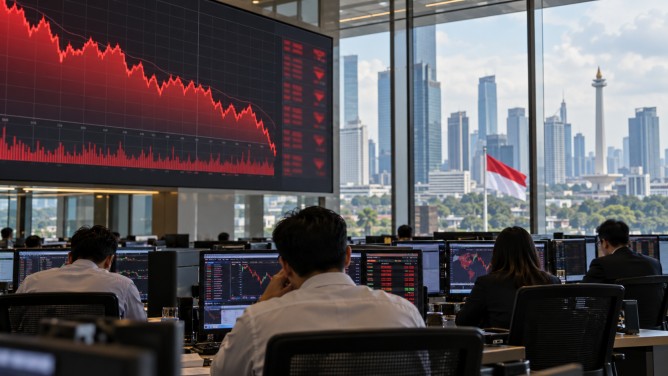
Indonesia’s stock market experienced a significant drop on Thursday, with the Jakarta Composite Index (JCI) falling by 1.51% to 5,247 points. This decrease of 80 points comes amid investor concerns over domestic monetary measures and ongoing global economic uncertainties. The index fluctuated throughout early trading, ranging from 5,185 to 5,350.
Trading volume was notable, with approximately 1.22 billion shares exchanged across 76,140 transactions, totaling a value of Rp 582.44 billion. The market decline was widespread, evidenced by 519 stocks losing value, while only 54 advanced and 106 remained unchanged.
In response to these market conditions, Bank Indonesia announced several monetary policy actions. The central bank held its benchmark interest rate steady at 5.75% and its lending facility rate at 6.5%, while raising the deposit facility rate by 25 basis points to 5%. Additionally, measures were introduced to attract foreign investment and bolster the rupiah, including plans to improve banking system liquidity by reducing the average reserve requirement for conventional commercial banks from 9% to 7% in two stages, with changes set to take effect in November and December of 2026.
Despite the weak domestic market, international investors showed interest in Indonesian stocks following a speech by President Prabowo Subianto. This was reflected in the US-listed iShares MSCI Indonesia ETF, which saw a gain of around 2%. However, analysts cautioned that these gains might not indicate a sustained recovery.
Global economic concerns, such as persistent inflation pressures and uncertainty over future market conditions, continue to affect investor sentiment. This was evident in other Asian markets as well, with Japan’s Nikkei 225, South Korea’s Kospi, Hong Kong’s Hang Seng, and Shanghai’s SSE Composite all experiencing declines.