
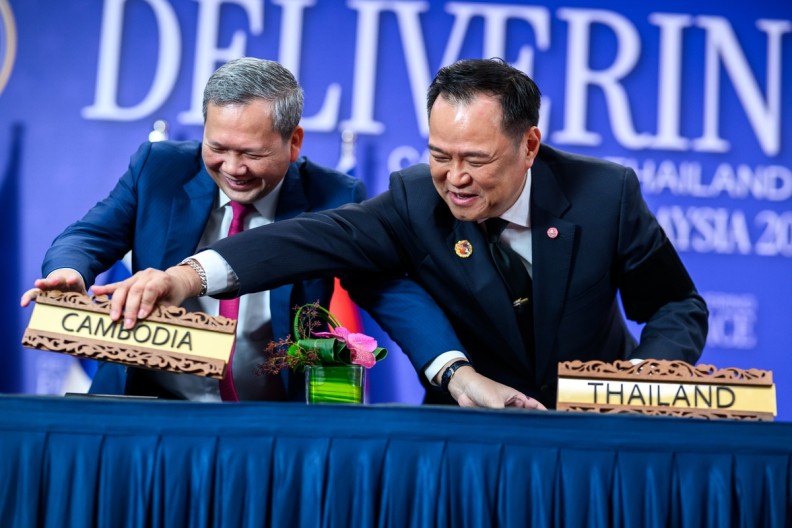
In a casual encounter preceding the ASEAN Future Forum in Hanoi, Vietnam, Cambodian Prime Minister Hun Manet and his Thai counterpart Anutin Charnvirakul exchanged pleasantries and engaged in a brief dialogue. This informal interaction occurred just before the commencement of the two-day forum, offering a moment for the two premiers to converse outside the structured events of the day. The leaders were captured on camera shaking hands outside the forum’s main venue, a gesture symbolizing ongoing diplomatic engagement between the neighboring nations.
Observers in Cambodia interpreted this exchange as a positive indication that dialogue between Cambodia and Thailand continues to thrive, despite ongoing disputes over border demarcations. Nevertheless, Thai officials were quick to clarify that this was merely an informal conversation, not a formal bilateral meeting, characterizing the exchange as a typical interaction while awaiting the start of the forum.
The ASEAN Future Forum, now in its third iteration, serves as a platform for regional leaders to deliberate on development agendas and fortify Southeast Asian collaboration. The forum’s discussions aim to align member states on priorities that transcend individual national interests, fostering a cooperative approach to the region’s collective challenges and opportunities.
During the event, Vietnam’s leadership highlighted the necessity for ASEAN nations to adapt to evolving global dynamics. They called for a focus on long-term growth strategies that incorporate innovation and prioritize the empowerment of younger generations. This forward-thinking approach, they suggested, is crucial for ASEAN to effectively tackle global challenges and capitalize on emerging opportunities.
The emphasis on innovation and youth-centered policies underscores a broader vision for sustained regional development. By advocating for stronger regional partnerships, Vietnamese leaders hope to galvanize ASEAN’s efforts toward creating a resilient and prosperous future for Southeast Asia.